Trilobita
Cambrian, Ordovician, Silurian, Devonian, Carboniferous
Global distribution (USA, Germany, Russia, etc.)
Multiple localities worldwide
Coloration Data
Original in-life color patterns consisting of dark bands, stripes, and spots have been documented across the exoskeletons and pygidia (tail shields) of numerous trilobite species. In addition, the calcitic lenses of their compound eyes emit a blue-green fluorescence under ultraviolet light, which led to popular speculation that trilobites had "glowing" eyes in the dark. However, such bioluminescent-like effects were almost certainly impossible in their natural benthic habitats, where ambient UV radiation fails to penetrate the water column to sufficient depths (discussed in detail by Schoenemann et al., 2015).
Macroscopic and microscopic visual examination of preserved cuticular pigment patterns.
Publications
-
David R. Kobluk & Royal H. Mapes (1989)
A review article on the coloration of Paleozoic marine invertebrates. -
Brigitte Schoenemann , Euan. N.K. Clarkson, Uwe Ryck (2014)
An article about the coloration of Devonian trilobites. -
Wells, J. W. (1942)
An article about the coloration of Ordovician trilobites from Ohio. -
Brigitte Schoenemann, Euan N.K. Clarkson and Gábor Horváth (2015)
An article about the fluorescence of trilobite eyes. -
Jakob Vinther (2015)
An overview of methods for reconstructing paleo‑coloration.
Documents and files
-
Schoenemann_et_al_2014.pdf (PDF)
Article by Schoenemann et al., 2014 on the coloration of Devonian trilobites. -
Schoenemann_et_al_2015.pdf (PDF)
Article by Schoenemann et al., 2015 on the fluorescence of trilobite eyes. -
Vinther_2015.pdf (PDF)
Review article on fossil color reconstruction.
Reconstructions
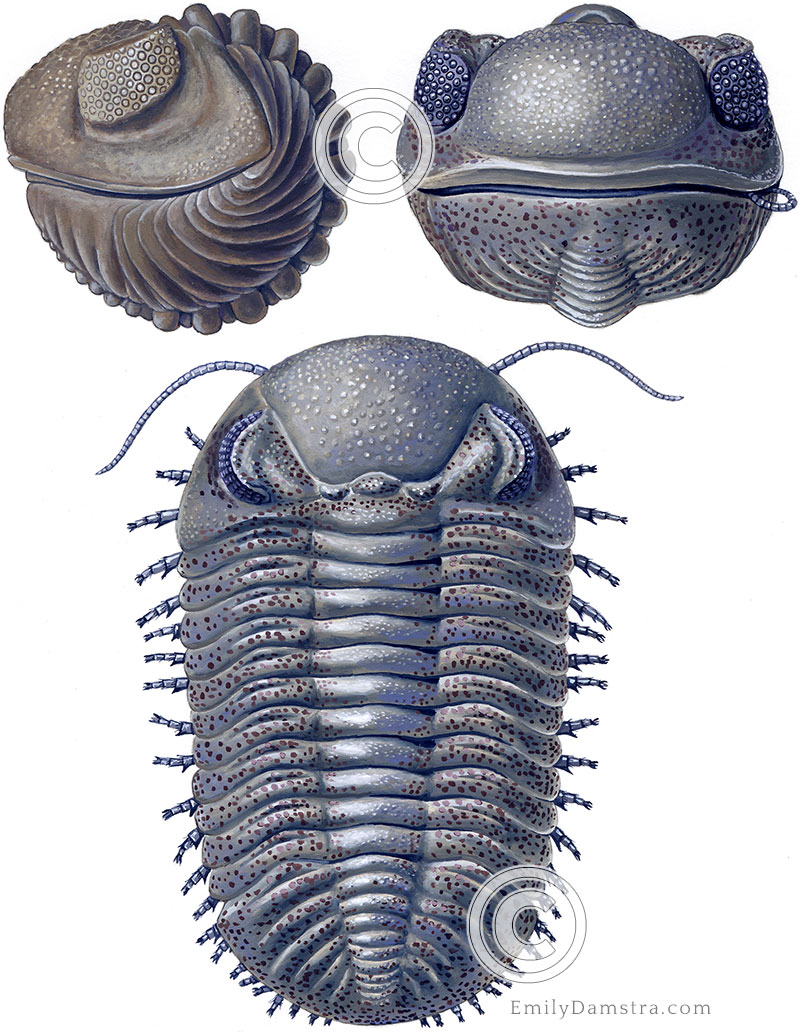 Reconstruction of the trilobite Eldredgeops with a spotted pattern on its exoskeleton. Original artwork by Emily S. Damstra.
Fossils
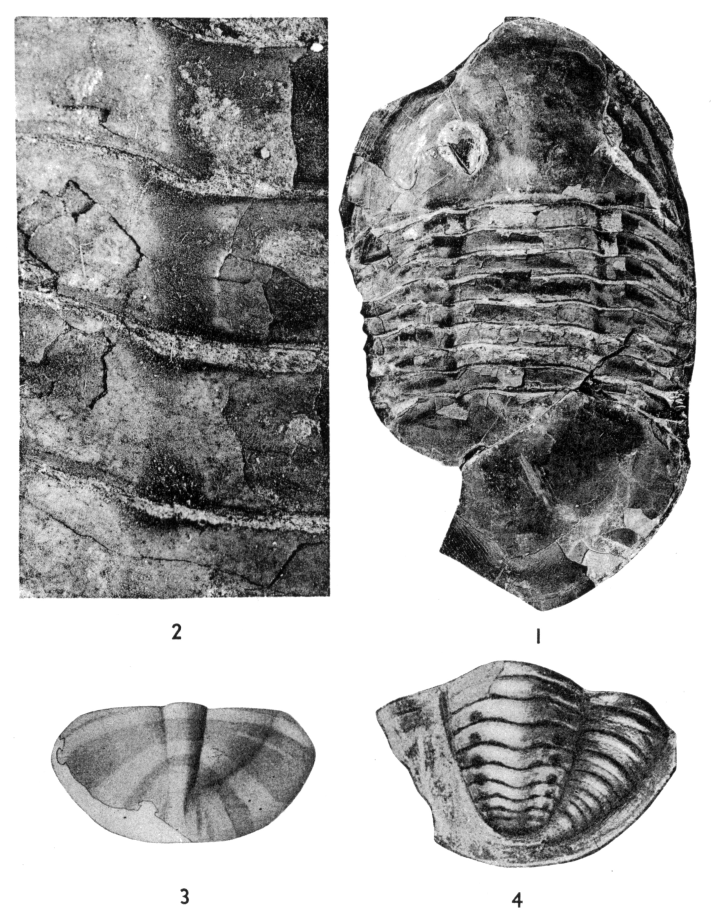 Photographs of trilobite specimens Isotelus maximus (1, 2), Anomocare vittata (3), and Proetus tenuituberculus (4).
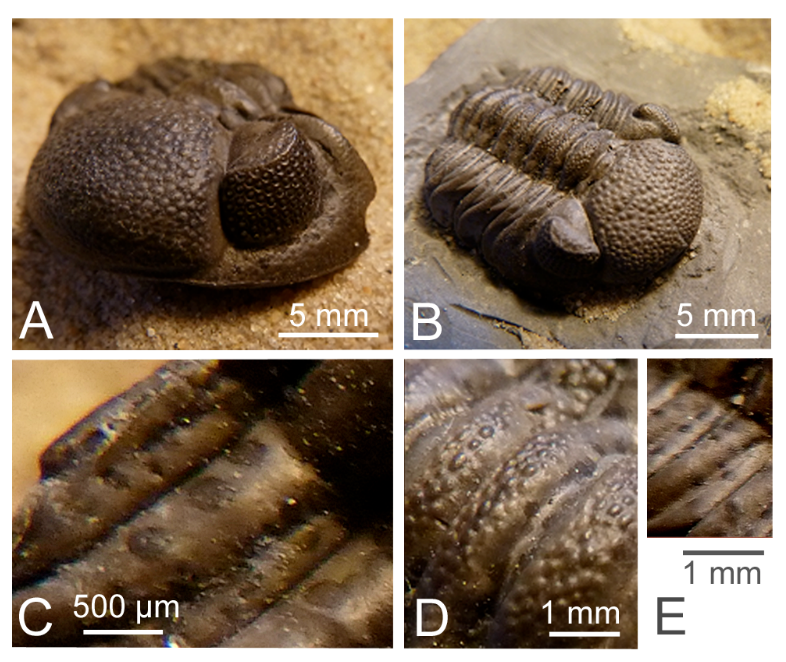 Pigment spots on the exoskeleton of the trilobite Eldredgeops crassituberculata.
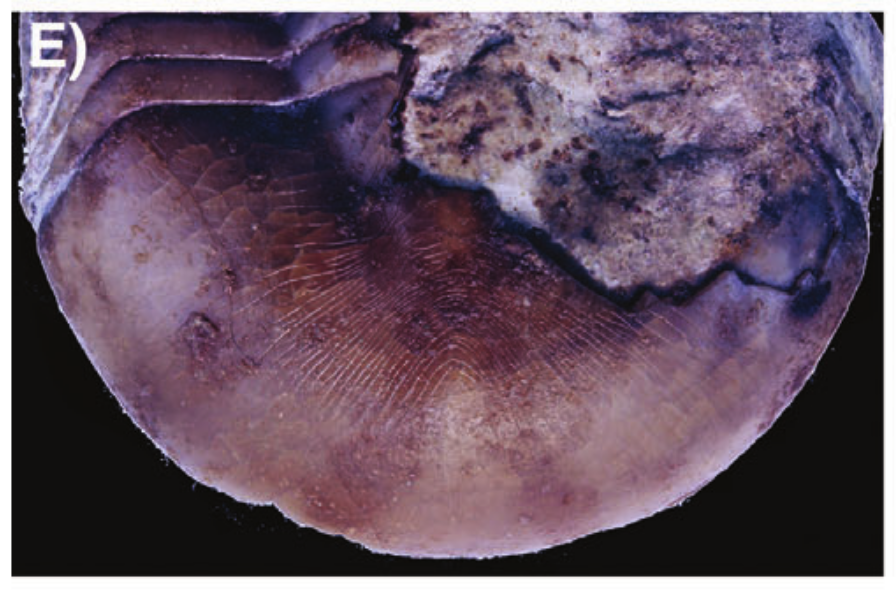 Photograph of an Illaenus specimen from Saint Petersburg with dark radial bands on the pygidium.