Canadia spinosa
Cambrian Epoch 2 (~508 million years ago)
British Columbia, Canada
Burgess Shale
Coloration Data
On the bristles of specimen USNM 202335, belonging to the polychaete worm Canadia spinosa, parallel grooves with a uniform periodicity were discovered. These grooves form an optical diffraction grating that imparted an iridescent sheen to the living animal. An identical structural adaptation is found in the setae of the Aphrodita, an extant marine polychaete.
Electron microscopy.
Publications
-
Parker A. R. (1998)
A study of the coloration of Wiwaxia corrugata, Canadia spinosa, and Marrella splendens.
Documents and files
-
Parker_1998.pdf (PDF)
Paper by Parker (1998) on Wiwaxia corrugata, Canadia spinosa, and Marrella splendens.
Reconstructions
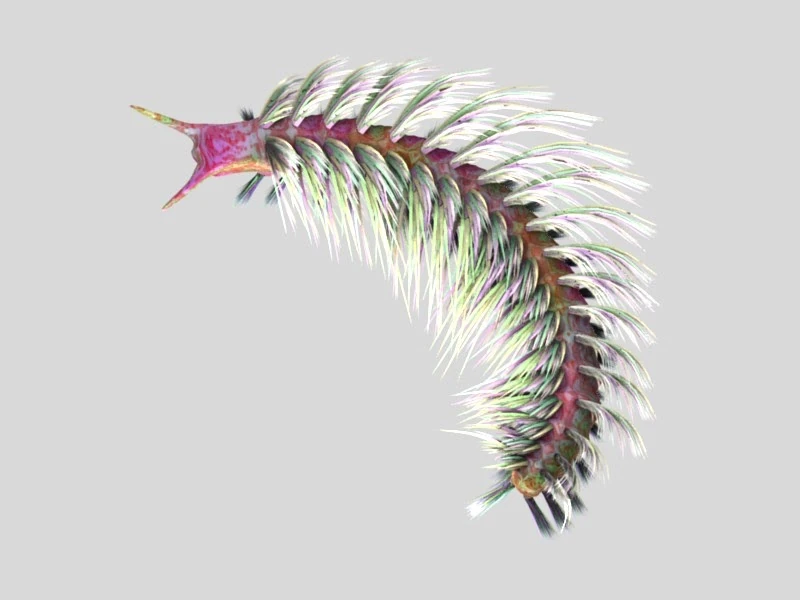 Reconstruction of the appearance of Canadia spinosa.
Fossils
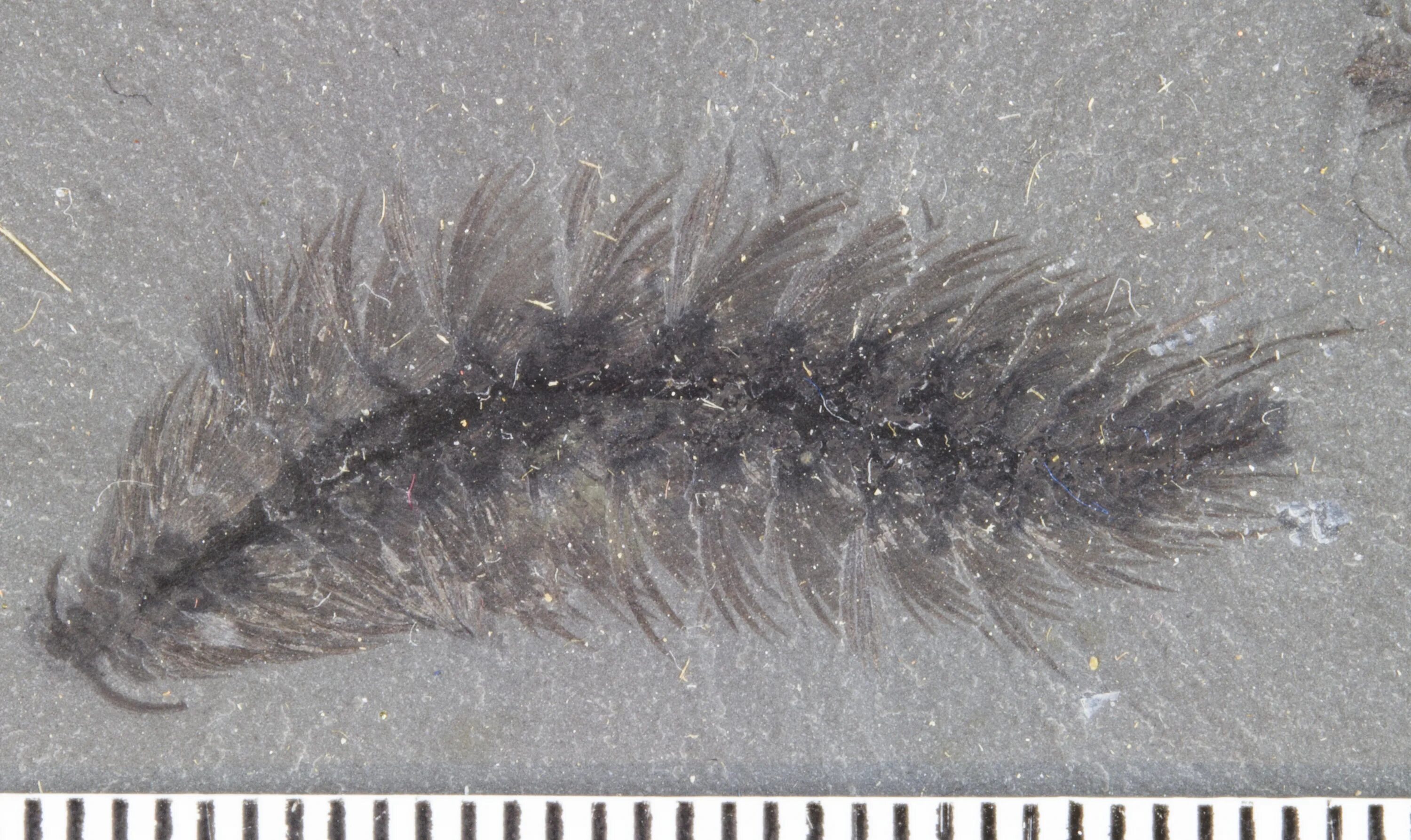 Photograph of a Canadia spinosa specimen with a millimeter scale bar.